
 pnewslive

From August 3, 2026, the closing price of every stock in the F&O segment comes from an auction instead of a 30-minute average. Long-term investors need to do nothing. Traders, index funds and arbitrage funds have a new routine to learn.
What changed
For over three decades, the closing price was the volume-weighted average (VWAP) of all trades between 3:00 pm and 3:30 pm. Nobody actually traded at that price. It was a calculation, not a transaction.Now, the roughly 200 stocks with futures and options stop normal trading at 3:15 pm and enter a Closing Auction Session. All buy and sell orders go into one pool. The exchange finds the single price at which the most shares can change hands, executes all matched orders at that price, and declares it the official close. Other stocks still close the old way at 3:30 pm, but NSE calls this a phased rollout, so expect them to follow.
The new timetable
The auction runs from 3:15 pm to 3:35 pm. First five minutes: the exchange sets a reference price, the VWAP of trades between 3:00 and 3:15 pm. Stop-loss orders are cancelled, and iceberg orders, which hide most of their size, are barred. Next five minutes: market and limit orders can be placed, changed or cancelled. From 3:25 pm: limit orders only, and the window shuts at a random, system-chosen moment between 3:28 and 3:30 pm. This stops anyone from timing a last-second order to push the close. Matching follows, and the price is out by 3:35 pm. Orders cannot stray more than 3 per cent from the reference price.Equity derivatives now trade until 3:40 pm, ten minutes longer, so traders can adjust positions after the underlying’s close is known.
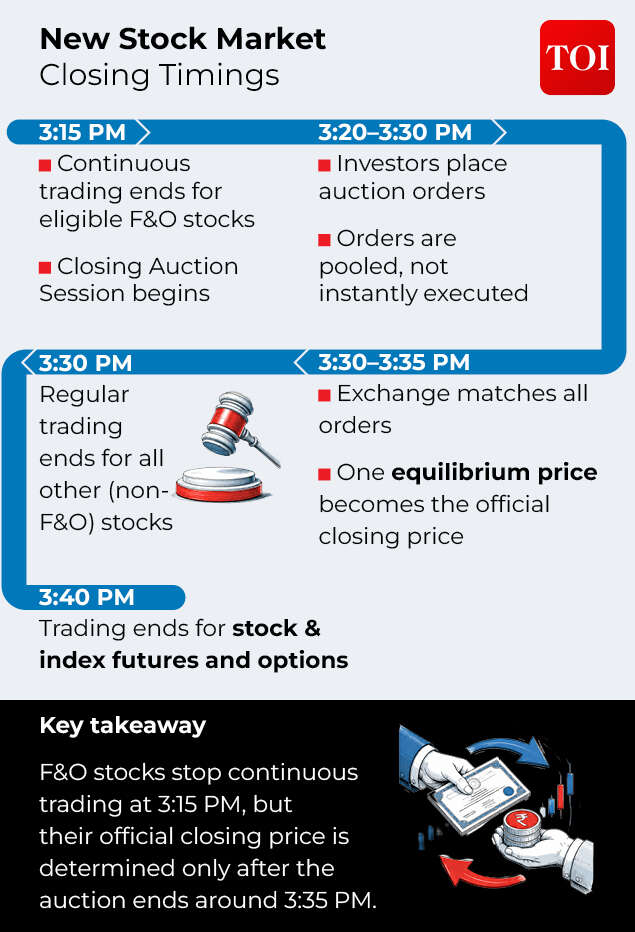
New stock market closing timings explained
What happened on day one
The first day was untidy. The Nifty spiked at the close; the Sensex did not. The two indices, which normally move together, ended the day apart, because a single auction print moves an index more sharply than a 30-minute average ever did. Arbitrageurs and market makers, who normally keep related prices in line, stayed out of the first auction to see how it worked. With few sellers in the pool, buy orders pushed several heavyweight stocks to the top of the 3 per cent band. The systems ran fine; it was the prices that went wrong.
The strange gap between spot and futures
The imbalance left the Nifty about 110 points above Nifty futures. Normally futures trade slightly above spot, since a futures price carries the cost of money until expiry. Spot closing above futures almost never happens, let alone by this margin.This matters most to arbitrage funds, which buy a stock and sell its futures to earn the difference. NAVs are computed automatically from closing prices; fund houses cannot substitute their own view of fair value. So the inflated spot close widened the spread on paper and pushed up arbitrage fund NAVs for a day. That bump was not real profit. Investors who redeemed on Monday were overpaid. Those who entered paid too much for their units, and the gain should reverse as prices normalise. For anyone who stays invested, the noise cancels out: spot and futures converge at expiry, and the fund’s return is realised in full.One risk remains open. Nifty derivatives expire every Tuesday, and final settlement uses the underlying’s close. Monday’s distortion came on a non-expiry day, which limited the damage. A repeat on expiry day would move real settlement money between traders. Watch whether the exchanges tighten the mechanism before that is tested.
Why the change is good
The old average had a basic flaw. An index fund promises to match the index, and the index is built on closing prices. But no fund could buy at a price calculated after the fact from 30 minutes of trades. It spread its buying across the half hour, hoped its average came close, and the gap became tracking error that you paid for. The auction fixes this: the close is now a real trade, and a fund moving a few thousand crores on an MSCI or FTSE rebalancing day can transact at exactly the closing price. Mumbai has joined New York, London, Frankfurt and Tokyo, which have all closed this way for years.
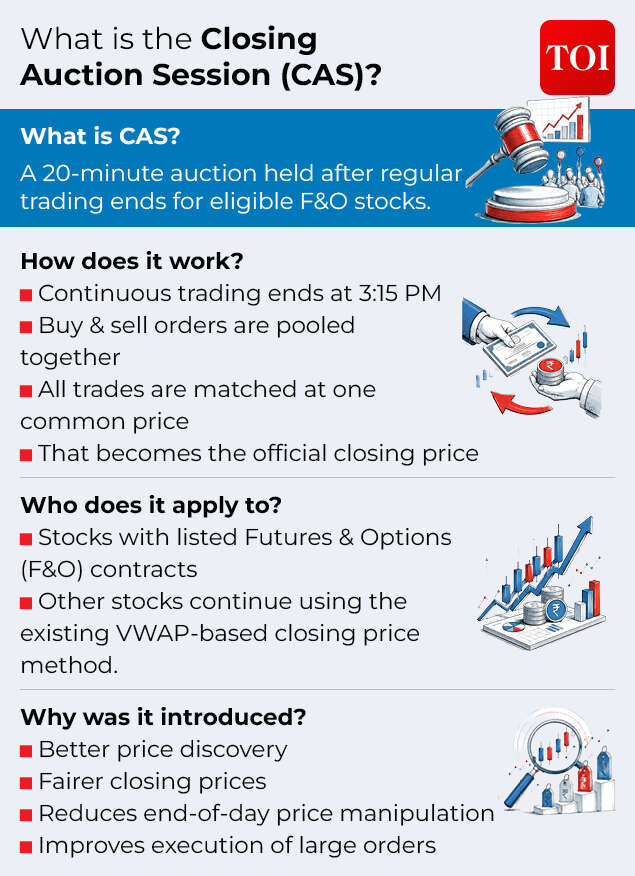
What is Closing Auction Session (CAS)?
What you should do
If you invest through SIPs and hold for years, nothing. The value of a business does not change because its closing price is discovered in an auction instead of computed as an average.If you hold index funds or ETFs, the change works in your favour. Tracking error should shrink, especially on rebalancing days. Watch the tracking difference your fund reports over the next year; it will tell you whether your fund house is using the auction well.If you hold an arbitrage fund, sit still. The NAV moves of the past two days are accounting noise, and your return will be realised at expiry. Avoid fresh lump-sum entries or exits until closing prices settle down, likely within days.If you trade intraday in F&O stocks, note the new deadline. Continuous trading ends at 3:15 pm, and your stop-loss orders die with it. Square up before that, or learn to use the auction.(Dhirendra Kumar is Founder and CEO of Value Research)
About the Author